Ch02. Matrix Algebra
2.3 Characterizations of Invertible Matrices
The Invertible Matrix Theorem
Theorem 8 : The Invertible Matrix Theorem
Let be a square matrix. Then the following statements are equivalent. That is, for a given , the statements are either all true or all false.
- (1). is an invertible matrix.
- (2). is row equivalent to the identity matrix.
- (3). has pivot positions.
- (4). The equation has only the trivial solution.
- (5). The columns of form a linearly independent set.
- (6). The linear transformation is one-to-one.
- (7). The equation has at least one solution for each in .
- (8). The columns of span .
- (9). The linear transformation maps onto .
- (10). There is an matrix such that .
- (11). There is an matrix such that .
- (12). is an invertible matrix.
- First, we need some notation.
- If the truth of statement (1) always implies that statement (10) is true, we say that (1) implies (10) and write .
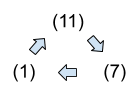
- The proof will establish the "circle" of implications as shown in the following figure.

- If any one of these five statements is true, then so are the others.
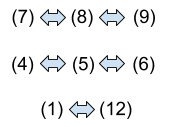
- Finally, the proof will link the remaining statements of the theorem to the statements in this circle.
Proof:
- If statement (1) is true, then works for in (10), so .
- Next, .
- Also, .
- If is square and has pivot positions, then the pivots must lie on the main diagonal, in which case the reduced echelon form of is . Thus .
- Also, .
- This completes the circle in the previous figure.
- Next, because works for .
- Also, and .
- So, and are linked to the circle.
- Further, and are equivalent for any matrix.
- Thus, and are linked through to the circle.
- Since is linked to the circle, so are and , because , , and are all equivalent for any matrix .
- Finally, and .
This completes the proof.
Because of Theorem 5, Theorem 8 (7) could also be written as The equation has a unique solution for each in .
- This statement implies (2) and hence implies that is invertible.
The following fact follows from Theorem 8. Let and be square matrices. If , then and are both invertible, with and .
- The Invertible Matrix Theorem divides the set of all matrices into two disjoint classes:
- the invertible (nonsingular) matrices, and
- the noninvertible (singular) matrices.
- Each statement in the theorem describes a property of every invertible matrix.
- The negation(부정) of a statement in the theorem describes a property of every singular matrix.
- For instance, an singular matrix
- is not row equivalent to ,
- does not have pivot position, and
- has linearly dependent columns.
Example 1:
Use the Invertible Matrix Theorem to decide if is invertible:
Solution:
- So has three pivot positions and hence is invertible, by the Invertible Matrix Theorem, statement (3).
- The Invertible Matrix Theorem applies only to square matrices.
- For example, if the columns of a matrix are linearly independent, we cannot use the Invertible Matrix Theorem to conclude anything about the existence or nonexistence of solutions of equation of the form .
- The next theorem shows that if such an exists, it is unique and must be a linear transformation. We call the inverse of and write it as
Invertible Linear Transformations
- Matrix multiplication corresponds to composition of linear transformations.
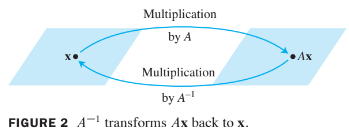
When a matrix is invertible, the equation can be viewed as a statement about linear transformations. See the following figure.
A linear transformation is said to be invertible if there exists a function such that
- for all in . (1)
- for all in . (2)
Theorem 9:
Let be a linear transformation and let be the standard matrix for . Then is invertible if and only if is an invertible matrix. In that case, the linear transformation given by is the unique function satisfying equation (1) and (2).
Proof :
- Suppose that is invertible.
- Then (2) shows that is onto , for if is in and , then , so each is in the range of .
- Thus is invertible, by the Invertible Matrix Theorem, statement (9).
- Conversely, suppose that is invertible, and let .
- Then, is a linear transformation, and satisfies (1) and (2).
- For instance, .
- Thus, is invertible.