Max-Norm Regularization
1. 핵심 개념
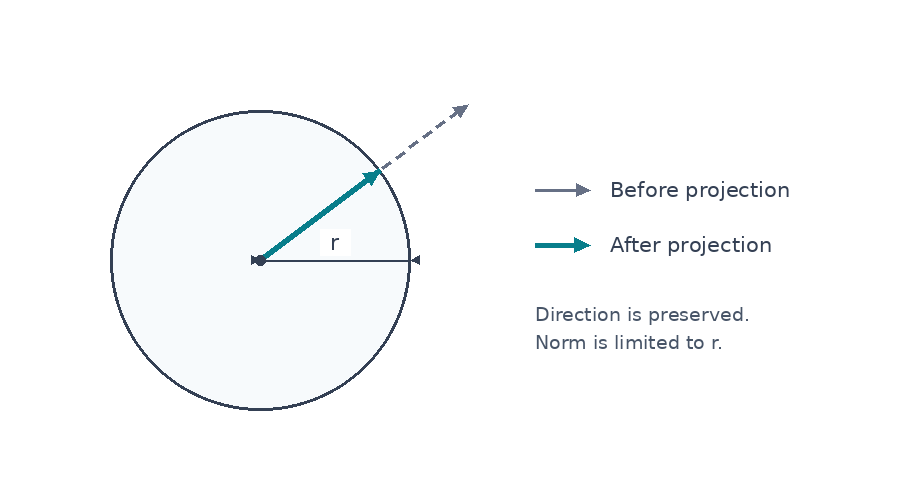
Max-Norm Regularization은
- 각 neuron 또는 filter의 weight vector가
- 너무 커지지 않도록 \(\ell_2\) norm의 상한을 두는 regularization 기법임.
여기서,
- \(\mathbf{w}\) : 하나의 neuron 또는 filter에 해당하는 weight vector
- \(||\mathbf{w}||_2\) : weight vector의 \(\ell_2\) norm
- \(r\) : 허용되는 최대 norm 값
max_norm: PyTorch 구현에서의 \(r\)
즉, weight가 학습 중 커지는 것은 허용하되, 정해진 크기 \(r\) 을 넘으면 다시 \(r\)로 줄이는 방식임.
L2 Regularization처럼 loss에 penalty를 추가하는 것이 아니라, 학습 후 weight를 feasible region 안으로 다시 넣는 방식에 가까움.
따라서 구현에서 가장 중요한 점은 다음임.
- bias에는 보통 적용하지 않음.
Linear에서는dim=(1,)사용.Conv계열에서는dim=tuple(range(1, weight.ndim))사용.BatchNorm,LayerNorm의 affine weight 같은 1D parameter에는 보통 적용하지 않음.optimizer.step()직후 적용함.max_norm은 반드시 tuning 대상임.
2. 적용 방식
Max-Norm Regularization은 loss function에 다음과 같은 항을 추가하지 않음.
대신 training step 이후 weight를 직접 검사함.
- weight norm이 \(r\) 이하이면 그대로 유지함.
- weight norm이 \(r\) 보다 크면 \(r\) 크기로 rescale함.
- weight vector의 방향은 유지하고 크기만 줄임.
수식으로 쓰면 다음과 같음.
여기서 \(\epsilon\) 은 division by zero를 피하기 위한 작은 값임.
3. 효과
max_norm 값인 \(r\) 을 작게 잡을수록 regularization이 강해짐.
- \(r\) 이 작음: weight 크기 제한이 강함.
- \(r\) 이 큼: weight 크기 제한이 약함.
- 너무 작으면 underfitting 가능성 증가.
- 너무 크면 regularization 효과 감소.
따라서 max_norm은 직접 tuning해야 하는 hyperparameter임.
Max-Norm Regularization은 특히 다음 상황에서 의미가 있음.
- weight가 지나치게 커지는 것을 막고 싶은 경우
- overfitting을 줄이고 싶은 경우
- Batch Normalization이나 Layer Normalization 없이 학습 안정성을 높이고 싶은 경우
- exploding gradient의 영향을 간접적으로 완화하고 싶은 경우
다만 gradient 자체를 clip하는 것은 아니므로, Gradient Clipping과는 구분해야 함.
4. PyTorch에서 중요한 점
중요한 것은 dim을 아무렇게나 고정하면 안 된다는 점임.
dim은 **어느 축을 따라 norm을 계산할지**를 의미함. 즉, 제한하고 싶은 단위가 neuron인지, filter인지에 따라 달라져야 함.
nn.Linear
nn.Linear의 weight shape은 다음과 같음.
하나의 output neuron은 weight matrix의 한 row에 해당함.
따라서 각 neuron의 incoming weight vector 전체에 대해 norm을 계산하려면 다음처럼 해야 함.
즉,
은 각 output neuron마다 하나의 norm을 계산함.
nn.Conv2d
nn.Conv2d의 weight shape은 다음과 같음.
하나의 output channel에 해당하는 filter 전체를 하나의 weight vector로 보려면 out_channels 축을 제외한 나머지 축 전체에 대해 norm을 계산해야 함.
따라서 Conv2d에서는 다음이 자연스러움.
즉, dim=1만 쓰면 filter 전체 norm이 아니라 일부 축에 대해서만 norm을 계산하게 되므로 일반적인 max-norm constraint로는 부정확함.
5. Layer별 norm 계산 기준
| Layer | weight shape | 제한 대상 | norm 계산 dim |
|---|---|---|---|
nn.Linear | [out_features, in_features] | 각 output neuron의 incoming weights | (1,) |
nn.Conv1d | [out_channels, in_channels, kW] | 각 output channel의 filter | (1, 2) |
nn.Conv2d | [out_channels, in_channels, kH, kW] | 각 output channel의 filter | (1, 2, 3) |
nn.Conv3d | [out_channels, in_channels, kD, kH, kW] | 각 output channel의 filter | (1, 2, 3, 4) |
핵심은 항상 같음.
첫 번째 축은 output unit 또는 output channel이고, 나머지 축 전체가 그 unit으로 들어오는 weight vector임.
6. 구현 예시
import torch
import torch.nn as nn


def apply_max_norm(model, max_norm=2.0, epsilon=1e-8):
    with torch.no_grad():
        for module in model.modules():

            if isinstance(module, nn.Linear):
                weight = module.weight
                norm_dims = (1,)

            elif isinstance(module, (nn.Conv1d, nn.Conv2d, nn.Conv3d)):
                weight = module.weight
                norm_dims = tuple(range(1, weight.ndim))

            else:
                continue

            actual_norm = torch.linalg.vector_norm(
                weight,
                ord=2,
                dim=norm_dims,
                keepdim=True,
            )

            scale = torch.clamp(
                max_norm / (actual_norm + epsilon),
                max=1.0,
            )

            weight.mul_(scale)
7. Training Loop에서의 위치
Max-Norm Regularization은 optimizer.step() 이후에 적용함.
순서로 보면 다음과 같음.
- loss 계산
- gradient 계산
- optimizer가 weight update
- max-norm constraint 적용
- gradient 초기화
즉, optimizer가 일단 weight를 바꾼 뒤, 그 결과가 \(||\mathbf{w}||_2 \le r\) 조건을 넘으면 다시 projection하는 방식임.