Sigmoid Linear Unit (SiLU) : from GELU to MiSH
SiLU 는 Sigmoid Linear Unit 의 약자로
ELU(2015) 이후- 2016년에 등장한 smooth activation function 계열 중 하나로,
- 여러 실험에서 ReLU 계열의 대안으로 좋은 성능을 보인 activation function임.
Swish(SiLU의 일반형, 2017)라는 이름으로도 잘 알려짐.Swish는 현재 deeper model이나 복잡한 dataset에서 ReLU의 대안 으로 사용되는 추세임.- 사실 \(\beta=1\) 을 기본값으로 쓰는 터라
SiLU와 잘 구별되지 않음.
- 사실 \(\beta=1\) 을 기본값으로 쓰는 터라
SiLU는 Swish 의 special case 이임, variants of ReLU 중 다음의 특성을 가지는 대표적 activation function 임:
- smooth,
- non-convex and
- non-monotonic
정확히 애기하면, 다음과 같음:
\(\text{SiLU}(x) = x \sigma(x) = {\left. x \sigma(\beta x) \right|}_{\beta=1} = {\text{Swish}}_{\beta=1}(x)\)
역사적으로는
GELU이후,- smooth하면서 non-monotonic한 ReLU 계열 activation function들이 더 주목받기 시작함.
- 2016년 \(\beta=1\)인 경우인 \(x \sigma(x)\)인
SiLU가GELU와 함께 제안됨.
- 2016년 \(\beta=1\)인 경우인 \(x \sigma(x)\)인
Swish는 이러한 흐름 속에서 제안된 activation function으로 볼 수 있음.- 이후 2017년에 \(\beta\)가 도입된 보다 generalized form의 Swish 로 등장함.
일부 문헌헤서는 복잡한 task에서 기본 activation으로 ReLU 대신 Swish를 권장하나
GPU 등에서 보다 최적화된 ReLU가 여전히 많이 이용됨.
단, transformer 의 FFN 에선 GELU가 기본적으로 많이 사용되어왔으며,
최근엔 SwiGLU (2020)가 보다 많이 사용되는 추세임.
참고: SwiGLU
참고로, SwiGLU 는 하나의 function이 아닌 unit임.
즉, activation unit으로 activation function을 포함한 더 넓은 계산 단위에 해당함.
- input \(\textbf{x}\)을 두 갈래로 나누고, 한쪽은 gate를 거친 후 다른 한쪽의 출력과 element-wise product (=Hadamard product)하는 구조
보다 자세한건 다음 URL을 참고: SwiGLU
Smooth, non-convex and non-monotonic variant of ReLU 의 시작 : GELU
ELU 까지의 activation functions 의 경우
다음의 특성을 공유함:
monotonic과convexity
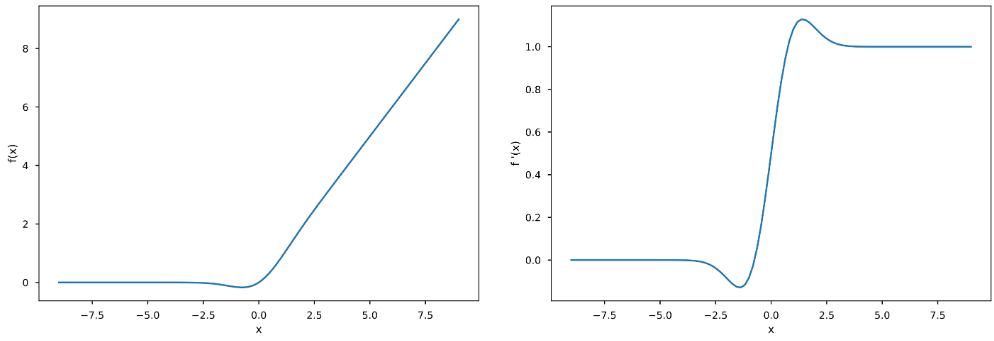
- left: \(\text{GELU}(x)\)
- right: \(\frac{d}{dx}\text{GELU}(x)\)
하지만 2016년 등장한 Gaussian Error Linear Unit (GELU)가
기존의 activation functions 이상의 성능을 보임에 따라,
monotonic 하지 않고 convexity 도 만족하지 않는 smooth 한 activation function 이 많이 이용되기 시작함.
Gaussian Error Linear Unit (GELU)
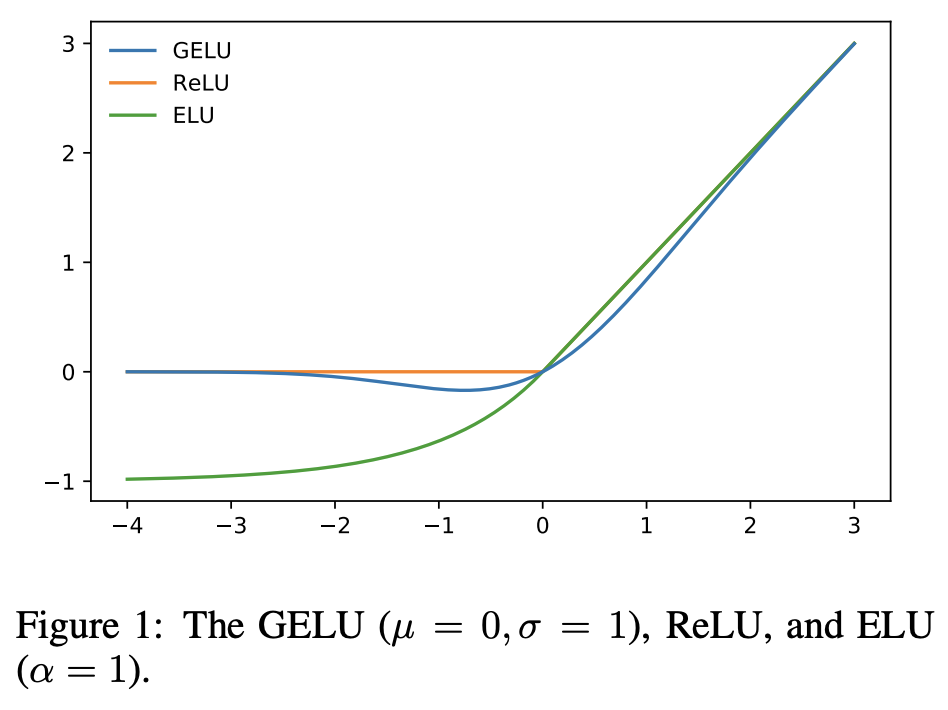
- standard Gaussian Cumulative Distribution Function (CDF) \(\Phi(x)\)를 이용함.
- \(x\)가 충분히 크면, \(\Phi(x) \approx 1\) 이므로 거의 그대로 통과.
- \(x \approx 0\) 면, \(\Phi(x) \approx 0.5\) 이므로 절반 정도만 반영됨.
- \(x\)가 음의 무한대에 가까우면, \(\Phi(x) \approx 0\)이므로 거의 제거됨.
- \(x\)를 얼마나 통과시킬지를 Gaussian CDF 를 이용하여 부드럽게 조절!
ReLU계열보다 훨씬 연산량이 많지만, 복잡한 task에서ELU를 포함 기존의 activation function들보다 우수한 성능을 보임
GELU는 좋은 성능을 보이지만 연산량이 많다는 단점 을 가지고 있음.
또 주목할 점은
GELU를 제안한 논문에서 Sigmoid Linear Unit (SiLU)를 같이 제안하고 이를 GELU와 비교하였다는 점임.
해당 논문에서는 SiLU는 GELU보다 떨어지는 성능으로 보고되었으나,
- 이후 더 단순한 수식임에도 GELU를 거의 그대로 모사할 수 있는
- Generalization 이 이루어지면서 보다 많이 사용이 되기 시작함.
GELU는 수식상으로 error function을 이용하여 표현
\(\Phi(x)=\frac{1}{2}\left[ 1+\text{erf}\left( \frac{x}{\sqrt{2}} \right) \right]\)
하지만, 실제 구현에선 다음의 근사식이 더 많이 이용됨:
\(\text{GELU}(x)\approx 0.5x \left[1+\tanh \left(\sqrt{\frac{2}{\pi}}(x+0.044715 x^3) \right)\right]\)
PyTorch 의 경우,
nn.GELU(approximate='tanh')를 통해 위 근사식을 사용 가능.
Sigmoid Linear Unit (SiLU or Swish)
MobileNetV3 계열에서
Swish를 계산량 측면에서 단순화한hard-swish가 사용됨.
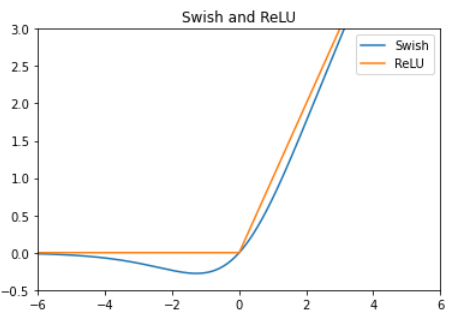
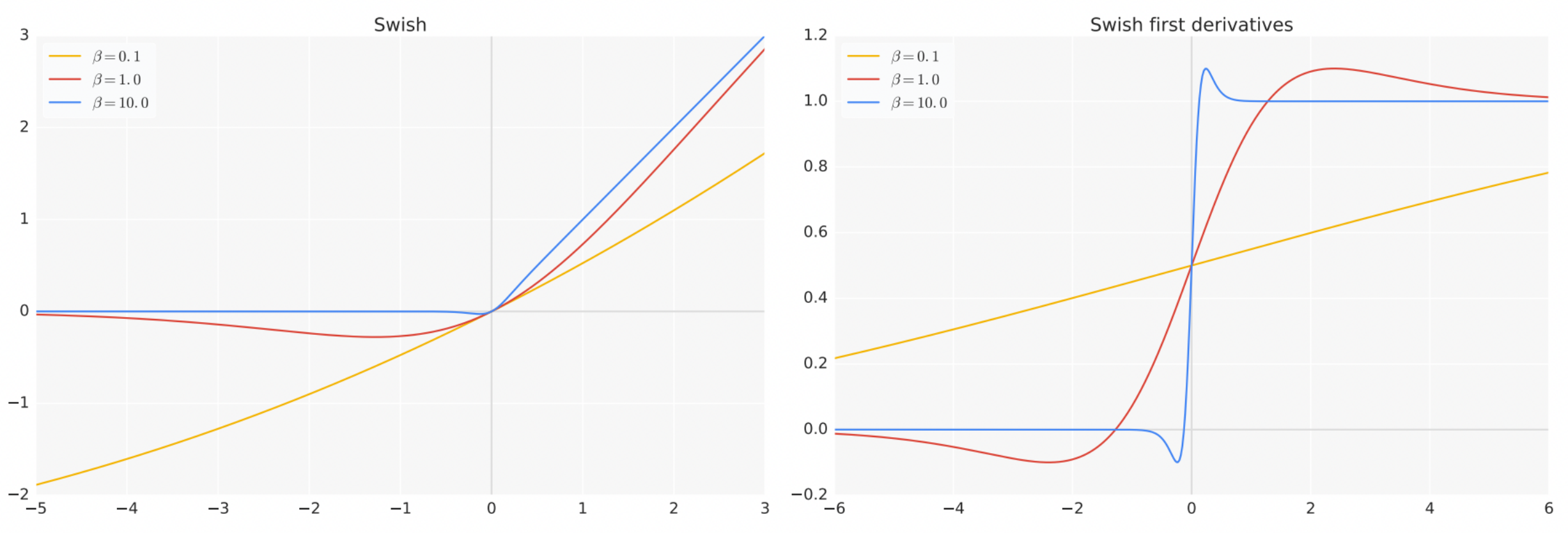
SiLU는 다음과 같이 sigmoid function을 기반으로 ReLU 및 GELU와 매우 흡사한 shape의 activation function을 만들 수 있음.
- \(\sigma (x)=\frac{1}{1+e^{-x}}\) : sigmoid function
아래 논문이 SiLU를 재발견한 논문임.
SiLU의 경우,
- sigmoid function의 input에
- \(\beta\)로 scaling을 하는 generalization 을 통해,
- GELU와 거의 동등한 동작 (연산의 측면에서는
GELU보다 우수함)보이도록 만들 수 있으며, - 보다 나은 성능을 얻을 수 있는 것으로 알려짐.
TensorFlow/Keras에서는 silu 또는 swish라는 이름으로 제공되며, 기본 수식은 다음과 같음.
PyTorch에선 \(\beta=1\)로 고정된 SiLU는 다음과 같이 제공하며
torch.nn에서nn.SiLU()로 제공.torch.functional에서F.silu(x)로 도 사용가능.
Swish는 다음과 같이 구현할 수 있음:
import torch
import torch.nn as nn


class Swish(nn.Module):
    def __init__(self, beta: float = 1.0):
        super().__init__()
        self.beta = beta

    def forward(self, x):
        return x * torch.sigmoid(self.beta * x)
PReLU와 같이 SiLU도 \(\beta\)를 trainable parameter로 삼는 parameterized Swㅑsh도 있음
(이 역시 PReLU 처럼 적은 학습데이터에선 over-fit할 확률이 커짐)
다음은 parameterized Swish 구현 코드(PyTorch)임:
class LearnableSwish(nn.Module):
    def __init__(self, beta: float = 1.0):
        super().__init__()
        self.beta = nn.Parameter(torch.tensor(beta))

    def forward(self, x):
        return x * torch.sigmoid(self.beta * x)
SiLU 미분
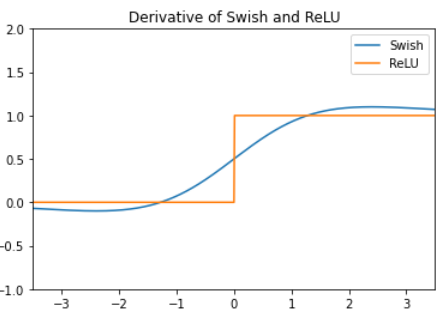
참고 : Mish
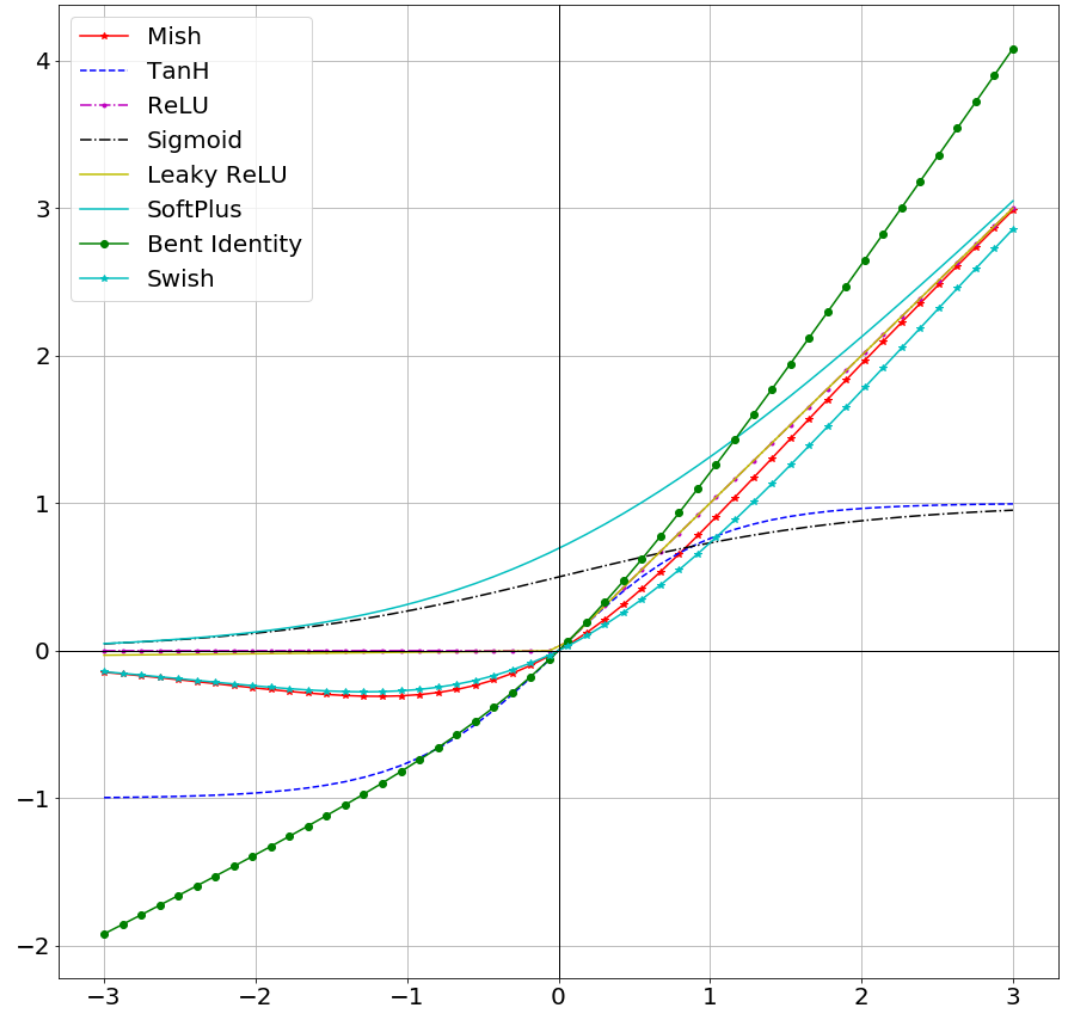
2019년에 Diganta Misra가 제안한 또다른 non-monotonic activation function 이 Mish.
- 해당 논문에 따르면
- 여러 CNN benchmark에서
Swish나GELU와 비교하여 - 동등 또는 좀 더 나은 성능을 보임.
Mish: A Self Regularized Non-Monotonic Activation Function
smooth function이면서 non-convex이고 non-monotonic하다는 특성을 가지며, softplus와 hyperbolic tangent를 조합한 activation function임.
- negative input에 대해선
Swish와 비슷 - positive input에 대해선
GELU와 비슷.
Swish와 비교하여 Mish는 좀더 강한 regularization 효과를 가지면서 gradient가 보다 smooth하다고 알려짐.
References
- Hyperbolic Tangent Function (tanh)
- Softplus
- Hands-On Machine Learning with Scikit-Learn, Keras, and TensorFlow, 3rd Edition
- [논문읽기]Mish(2019), A Self Regularized Non-Monotonic Activation Function